README
Ada-LEval
The official implementation of "Ada-LEval: Evaluating long-context LLMs with length-adaptable benchmarks"
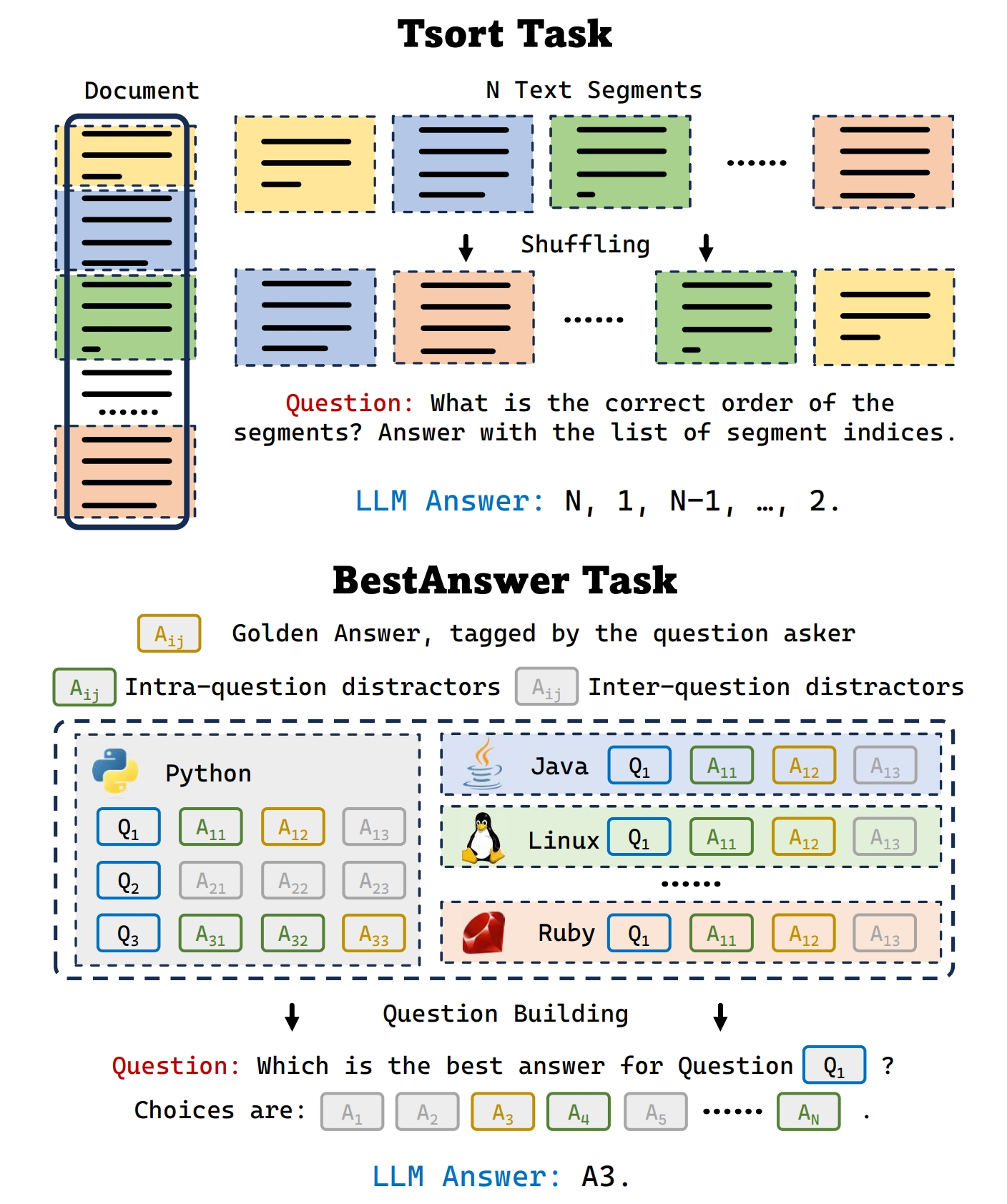
Ada-LEval is a pioneering benchmark to assess the long-context capabilities with length-adaptable questions. It comprises two challenging tasks: TSort, which involves arranging text segments into the correct order, and BestAnswer, which requires choosing the best answer of a question among multiple candidates.
Both tasks feature the following advantages:
- Controllable Test Cases: The length of each test case can be finely tuned - by adjusting the number and length of text segments in TSort and altering the number of distractor options in BestAnswer.
- Necessity for Full-Text Comprehension: Successful completion of both tasks mandates complete reading and understanding of the provided text.
- Precise Accuracy Measurement: The design of these tasks allows for unambiguous accuracy calculation. TSort has a definitive 'correct' order, while in BestAnswer, the annotated responses by the questioner serve as definitive answers.
🛠️QuickStart
In this repo, we implement the evaluation of Ada-LEval on GPT-4-Turbo-0125 (an example for APIs) and internlm2-[7b/20b] (an example for opensource LLMs). You can follow our implementation to evaluate Ada-LEval on your custom LLMs.
-
Preparation
-
Installation and data preparation
cd Ada-LEval pip install -e . bash fetch_data.sh -
For evaluating GPT-4, please set the environment variable:
export OPENAI_API_KEY=sk-xxxxx- Cost Estimation for GPT-4-Turbo-0125:
setting (2k, 4k, etc.) * n_samples * $0.01 / 1000
- Cost Estimation for GPT-4-Turbo-0125:
-
For evaluating InternLM2-7B, please follow the official guide to install LMDeploy.
-
-
Evaluate GPT-4-Turbo-0125:
python run.py --data {dataset_name} --model gpt-4-0125 -
Evaluate InternLM2-7B:
bash run.sh --data {dataset_name} --model internlm2-7b
* dataset_name can be stackselect_{setting} (for BestAnswer) or textsort_{setting} (for TSort). For example, stackselect_16k, textsort_2k, etc.
** run.sh detect the number of available GPUs and do the data parallel.
📊Evaluation Result
Here is the evaluation result of TSort and BestAnswer benchmark under long-context & ultra-long-context settings. We also provide a 'random guess' baseline for each task.
Definition: long-context -> context window < 32k; ultra-long-context: context-window >= 32k
The Number of Evaluation Samples: 1. API models on long-context: 200; 2. API models on ultra-long-context: 50; 3. Open-source models on long-context: 1000; 4. Open-source models on ultra-long-context: 200.
TL;DR:
- TSort is an extremely challenging benchmark: We observe positive results (significantly better than random guess) only when evaluating SOTA API models (GPT-4 series) under short context settings (< 8k).
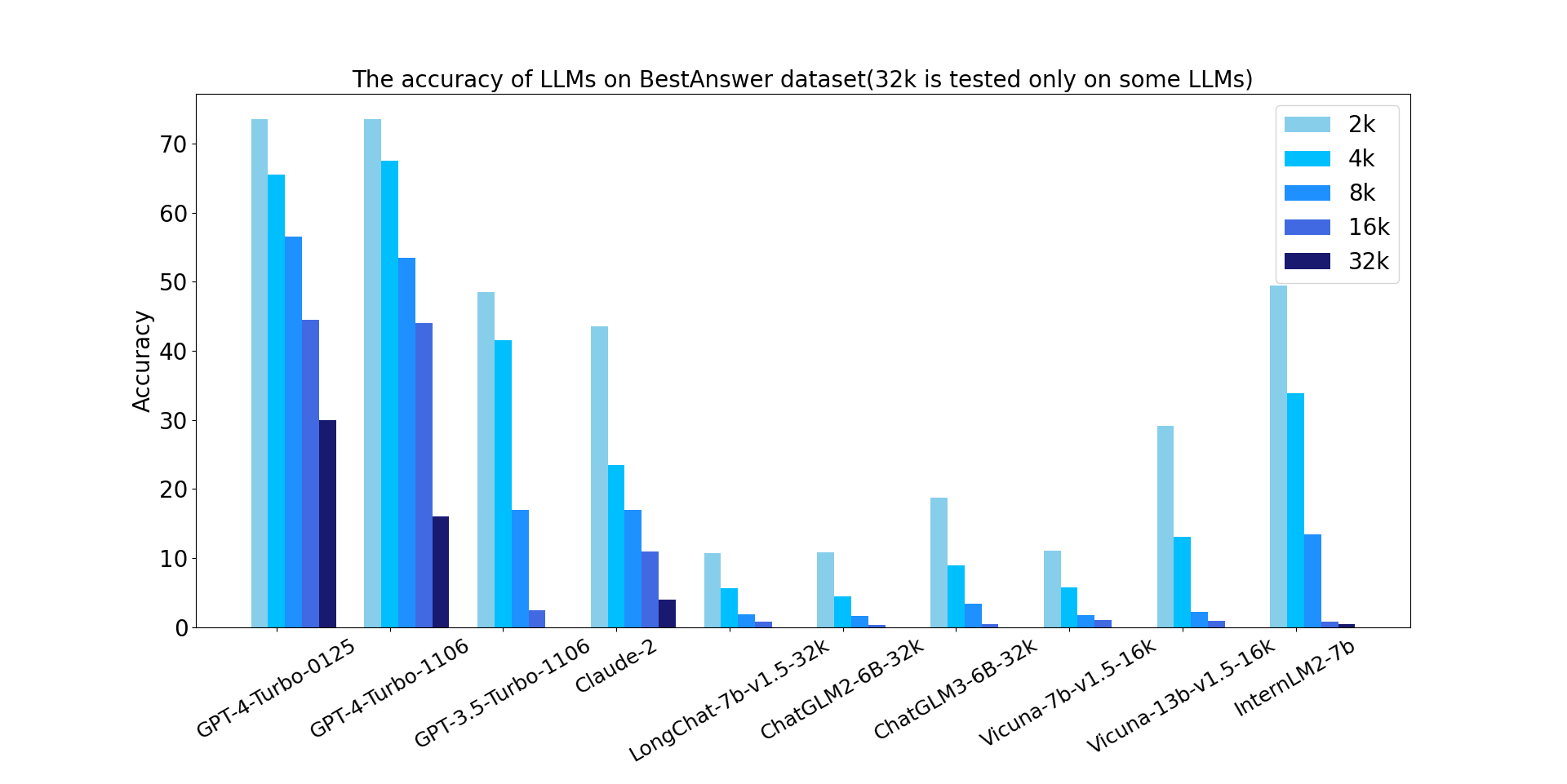
- BestAnswer is a challenging long-context benchmark with discrimination: With 32k long-context, GPT-4-Turbo-0125 still obtains a decent 30% accuracy, while other models significantly lag behind. When the context window is 64k or even longer, models failed to solve almost all of the questions.
TSort Evaluation Results
Blanks indicate the result under the corresponding setting is not evaluated.
| TSort | 2k | 4k | 8k | 16k | 32k | 64k | 128k |
|---|---|---|---|---|---|---|---|
| GPT-4-Turbo-0125 | 15.5 | 16.5 | 8.5 | 5.5 | 2.0 | 4.0 | 2.0 |
| GPT-4-Turbo-1106 | 18.5 | 15.5 | 7.5 | 3.5 | 6.0 | 6.0 | 6.0 |
| GPT-3.5-Turbo-1106 | 4.0 | 4.5 | 4.5 | 5.5 | |||
| Claude-2 | 5.0 | 5.0 | 4.5 | 3.0 | 0.0 | 0.0 | |
| LongChat-7b-v1.5-32k | 5.3 | 5.0 | 3.1 | 2.5 | |||
| ChatGLM2-6B-32k | 0.9 | 0.7 | 0.2 | 0.9 | |||
| ChatGLM3-6B-32k | 2.3 | 2.4 | 2.0 | 0.7 | |||
| Vicuna-7b-v1.5-16k | 5.3 | 2.2 | 2.3 | 1.7 | |||
| Vicuna-13b-v1.5-16k | 5.4 | 5.0 | 2.4 | 3.1 | |||
| InternLM2-7b | 5.1 | 3.9 | 5.1 | 4.3 | |||
| Random Guess | 4.2 | 4.2 | 4.2 | 4.2 | 4.2 | 4.2 | 4.2 |
BestAnswer Evaluation Results
Blanks indicate the result under the corresponding setting is not evaluated.
| BestAnswer | 1k | 2k | 4k | 6k | 8k | 12k | 16k | 32k | 64k | 128k |
|---|---|---|---|---|---|---|---|---|---|---|
| GPT-4-Turbo-0125 | 73.5 | 73.5 | 65.5 | 63.0 | 56.5 | 52.0 | 44.5 | 30.0 | 0.0 | 0.0 |
| GPT-4-Turbo-1106 | 74.0 | 73.5 | 67.5 | 59.5 | 53.5 | 49.5 | 44.0 | 16.0 | 0.0 | 0.0 |
| GPT-3.5-Turbo-1106 | 61.5 | 48.5 | 41.5 | 29.5 | 17.0 | 2.5 | 2.5 | |||
| Claude-2 | 65.0 | 43.5 | 23.5 | 15.0 | 17.0 | 12.0 | 11.0 | 4.0 | 0.0 | |
| LongChat-7b-v1.5-32k | 32.4 | 10.7 | 5.7 | 3.1 | 1.9 | 1.6 | 0.8 | |||
| ChatGLM2-6B-32k | 31.2 | 10.9 | 4.5 | 1.6 | 1.6 | 0.0 | 0.3 | |||
| ChatGLM3-6B-32k | 39.8 | 18.8 | 9.0 | 5.0 | 3.4 | 0.9 | 0.5 | |||
| Vicuna-7b-v1.5-16k | 37.0 | 11.1 | 5.8 | 3.2 | 1.8 | 1.9 | 1.0 | |||
| Vicuna-13b-v1.5-16k | 53.4 | 29.2 | 13.1 | 4.3 | 2.2 | 1.4 | 0.9 | |||
| InternLM2-7b | 58.6 | 49.5 | 33.9 | 12.3 | 13.4 | 2.0 | 0.8 | 0.5 | 0.5 | 0.0 |
| Random Guess | 26.7 | 10.1 | 4.5 | 3.0 | 2.3 | 1.4 | 1.1 | 0.6 | 0.3 | 0.1 |
🖊️Citation
@inproceedings{wang2024ada,
  title={Ada-LEval: Evaluating long-context LLMs with length-adaptable benchmarks},
  author={Wang, Chonghua and Duan, Haodong and Zhang, Songyang and Lin, Dahua and Chen, Kai},
  booktitle={Proceedings of the 2024 Conference of the North American Chapter of the Association for Computational Linguistics: Human Language Technologies (Volume 1: Long Papers)},
  pages={3712--3724},
  year={2024}
}